Saturday, March 25, 2017

My New Anallacta methanoides Ootheca! (Edited)

I just got an ootheca (2 actually, though one sadly got crushed during the trip over here), of this lovely species from a good friend of mine, Sebastien Marcaillou, I'm very happy to have an ootheca from this unique species, and I'm really hoping that I can help to establish them in culture in the US again, as apparently all the other colonies here have died out.

I have it housed in a small sized plastic container with coconut fiber as the substrate, which I am trying to keep semi-moist, and have bark pieces and dead leaves as hides. I will be feeding the resulting nymphs, (should I get any) dog food and veggies.

Here are some pictures of the ootheca:


And some pics of the enclosure


Really hoping that the ootheca will hatch and that the nymphs will do well for me, I would really love for this species to be established in the US hobby again, it's such a unique and interesting Ectobiid!

Well, that's going to be it for this post, I hope you guys enjoyed, it's very rare that I post two days in a row, but I really didn't want to wait any longer to share this great news! Anyways, I'll see you all next time! :)

EDIT: Well unfortunately this ooth turned out to be a dud, after a few hours of being in a moist enclosure the seam down the middle loosened up and revealed that the insides were black and rotten. :(

Don't know if it died during shipping or if it was just an infertile ooth, either way I won't be getting any nymphs from it unfortunately. Oh well, will just have to try again later I suppose, just goes to show, don't judge an ooth by it's outer appearance, because while it may look healthy, it could be dead inside! (Like all my Dorylaea orini ooths....).

Friday, March 24, 2017

Arenivaga bolliana Update

A few days ago, I was checking up on my Arenivaga bolliana enclosure, and I saw something small moving through the substrate. Upon closer examination, it turned out to be a tiny little Arenivaga hatchling! A quick search through the substrate revealed several more nymphs. Looks like I have successfully bred this species, this is the first time I have gotten offspring from a member of this genus, and I'm very happy about it!

Anyway, here are some pictures of the little cuties:


Really hope they'll grow well for me, I love this species, it's like a mini native Polyphaga! (In fact large females of this species are about the same size as smaller P.aegyptiaca females).

Anyway, I hope you guys enjoyed this post, I'll see you all next time! :)

Wednesday, March 22, 2017

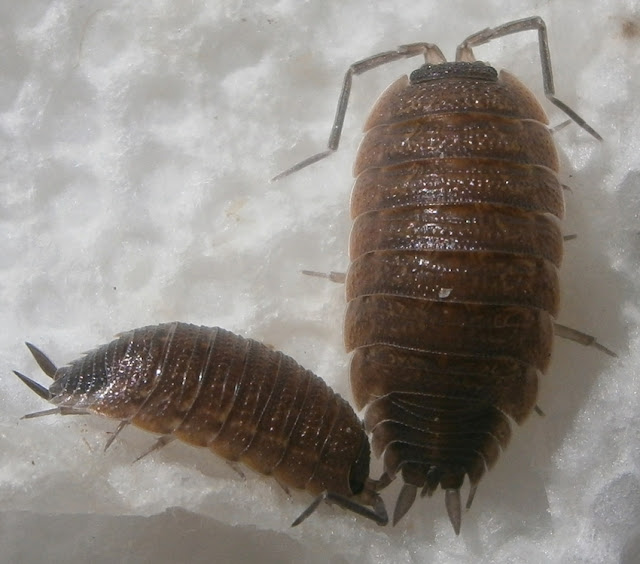
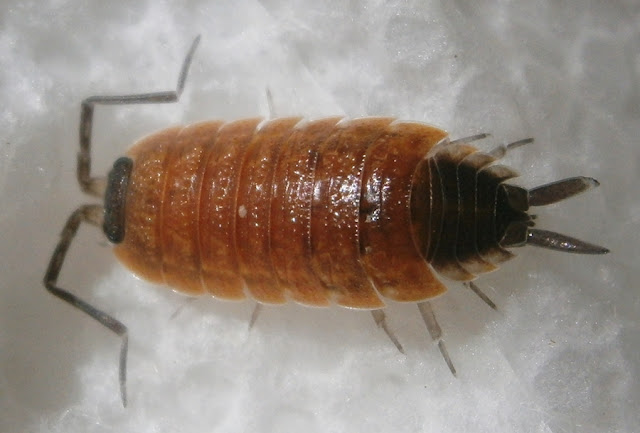
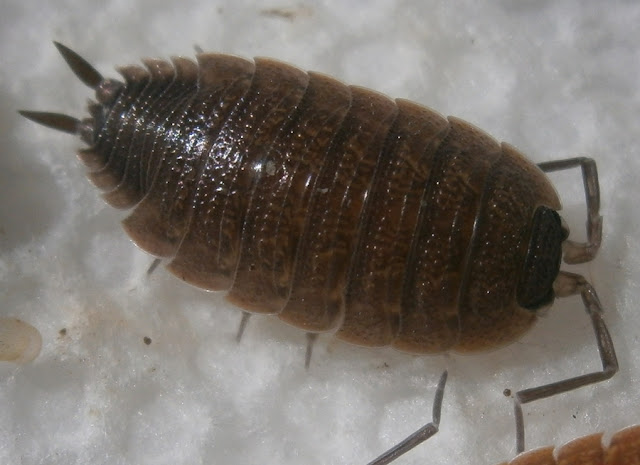
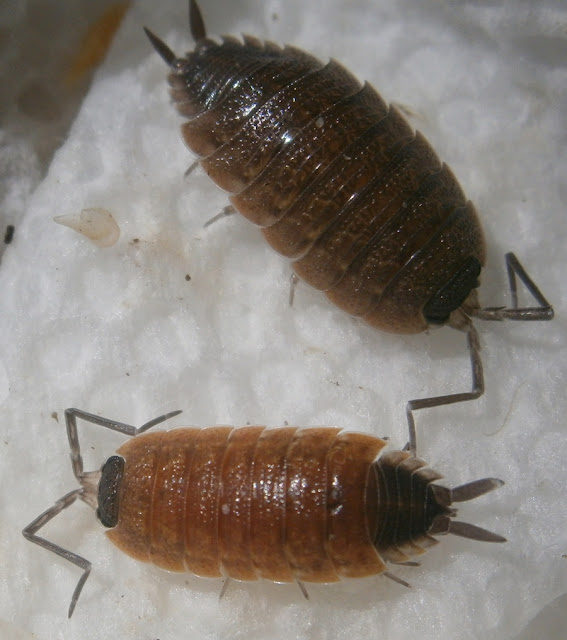
My New Porcellio silvestrii!!

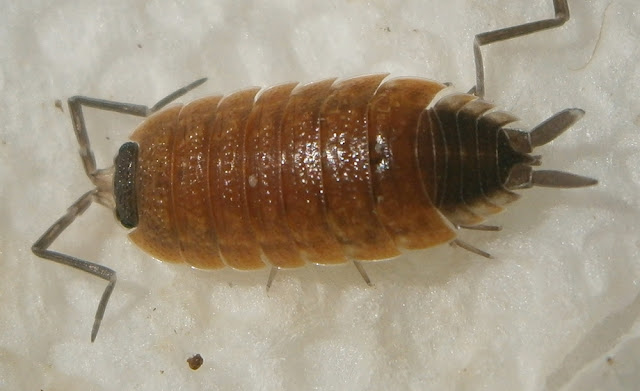
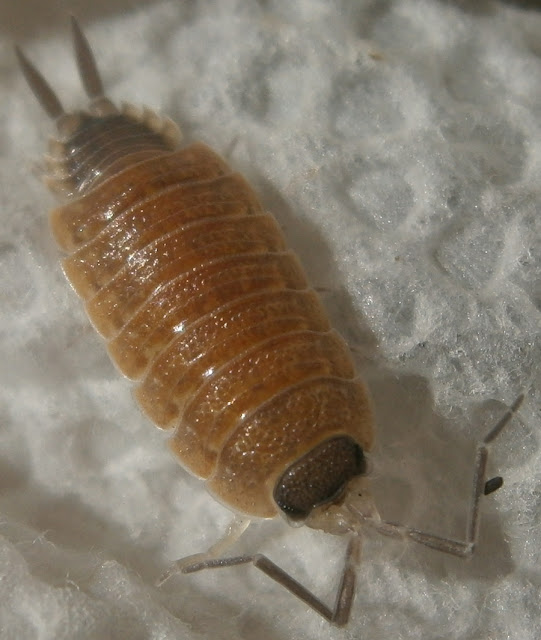
Today I received my end of a trade with Alan Grosse, owner of this lovely isopod store here, and the guy who I sold some of my original "Pied" Cylisticus convexus to. I traded some of my Oniscus asellus "Mardi Gras Dalmatian" (yes, that's what I'm calling them), for some of his Porcellio silvestrii. They all arrived safe and sound, and though I only traded for eight, he sent a freebie as well. :)

This species has a grey and an orange morph, with some individuals displaying coloration of both, however the coloration seems to be random and apparently can not be isolated. P.silvestrii likes it drier than most of the more commonly kept isopod species, as is normal for the Spanish Porcellio species, the enclosure should be fairly dry with a moist spot for them to retreat to. This is one of the easiest to breed species from Spain, and is great for practicing the care needs of the rarer species like Porcellio bolivari and Porcellio magnificus.

Here are some pictures of them:


And here is their enclosure
Really excited to have this species in my collection, hopefully I'll be able to breed them without too much trouble, then I can maybe branch off into the rarer species like P.bolivari!

Anyway, that's gonna be it for today, I hope you guys enjoyed this post, and I'll see you all next time! :)

Wednesday, March 15, 2017

My New Compsodes schwarzi & Parcoblatta caudelli!

Today I got my end of a trade with Alan Jeon, (AKA Cariblatta lutea on the Allpet roaches forum), I got a group of about 10 Compsodes schwarzi, a really small native roach species in the family Corydiidae, and the only member of it's genus in the hobby, and he also sent a free group of Parcoblatta caudelli as a little birthday gift, (my birthday was this Monday), which was really nice of him. :)

The Compsodes schwarzi are very cute little things, most of mine are presub adults, and there are a couple subadults as well. Apparently they are usually found in or around ant nests, as Alan and Kyle Kandilian collected them from trapjaw ant nests, (presumably Odontomachus clarus) last year, and another member of the Allpet roaches forum found a few in an ant colony a few years back, didn't mention which species of ant though...

Luckily in captivity they have proven easy to care for and breed, and don't seem to require being kept with ants at all! I am keeping them in a small plastic container with a layer of moist coconut fiber as the substrate, and I have placed a bunch of small pieces of bark in the enclosure as hides. I also added a few small white springtails to the enclosure, (which I believe are Cyphoderus similis, which incidentally are also commonly associated with ants), and will be feeding the roaches mostly dog food.

Here are some pictures of the Compsodes:


I love these little guys, I'm really hoping they'll do well for me!

The Parcoblatta caudelli nymphs are quite large compared to the other Parcoblatta species I have, I love their coloration as well! They are very active and fast, and I am very happy to have them in my collection!

I have them in a medium sized plastic container with a layer of moist coconut fiber as the substrate, with cardboard pieces and dead leaves as hides. Their diet will be mainly dog food, supplemented with carrots from time to time.

Here are some pictures of the nymphs:


Really love this species of Parcoblatta, it's the only species which has macropterous females, (except for certain strains of P.pennsylavanica), and the females can even fly! Hope they breed well for me!

Anyway, that's gonna be it for today, I hope you guys enjoyed this post, and I'll see you all next time! :)

Friday, March 10, 2017

A Couple of Darkling Beetle Updates

My Coelus ciliatus are doing pretty well, they have been laying quite a few new eggs, and I have been rearing lots of the older larvae to adulthood. What's cool about these guys is that, when the adult ecloses and darkens up into an orange-ish color, it burrows up to the surface and wanders around the deli cup, making it easy to both find which ones have matured and to remove them. This species really likes leaf litter BTW, seems they prefer it over dog food!

Here is are some pictures of a newly emerged adult and it's "emergence" hole:


And here are a couple of other teneral adults:


Glad this species has been doing so well for me, I hope I'll get the chance to work with other species from this genus one day!

My Eleodes clavicornis have also been doing very well, I started with a single pair, and now I have over a dozen adults, which have been producing their own larvae too. They have not proven to be a prolific species, but they can definitely be bred over multiple generations in captivity without too much trouble.

Here are some pics I took of the adults today:


It's a very cute little species of Eleodes, one that certainly deserves a spot in any Tenebrionid enthusiast's collection!

Anyway, that's gonna be it for today, I hope you guys enjoyed this post, and I'll see you all next time! :)

Saturday, March 4, 2017

Hanging On by a Thread...

Well, as you guys may know, I am down to one female Arenivaga tonkawa. I have been pretty confused as to what age she is, when I got her I thought she was an adult due to her size, however after several months of never seeing her lay a single ooth, fertile or otherwise, I assumed that she was still a nymph. 

However, today after checking on her, I found that she was beginning to laying an ooth! I have no idea whether it's fertile or not, she has not molted once in my care so I got her as an adult, so there is a chance she had already mated when I got her. However, I still have no idea why she has not laid any oothecae before now, even if she has not mated, she should still lay infertile oothecae like most roaches do. 

I have noticed that my adult A.cf.genitalis female has not laid any ooths at all in the few months she's been mature though, so perhaps Arenivaga females do not lay infertile oothecae like other roaches do, maybe to conserve more resources. But if this ootheca is fertile, I still don't know why she has not laid any other ooths prior to this one, I have searched through the substrate and have not found any oothecae at all, maybe I need to look closer...

Anyway, here are some pictures of the female laying the ootheca!


Hopefully this oothecae turns out to be fertile, would be nice to get babies out of this species without having to buy more!

My Dorylaea orini adults are starting to die off, and most of the oothecae have turned out to be infertile, even some of the good looking ones. :( I have taken out the last 5 oothecae that look fairly healthy, there is a good chance that they are all duds, but I'm keeping my fingers crossed that some may hatch! 

Here is a picture of the oothecae:


I really hope at least one ooth hatches, I really wanted this species to do well for me, they are very beautiful!

Unfortunately it seems my Rhabdoblatta formosana colony is crashing, NONE of my adults are reproducing, they keep aborting their oothecae, I even separated a few individuals to their own, new enclosure, and still no luck. I'm pretty sure it's the large numbers of Alphitobius diaperinus and Porcellio scaber that are stressing them out, so this week I will be completely cleaning out their cage of all other invertebrates and replacing the substrate and decor in a last-ditch effort to save my culture, though I'm not too optimistic that it will change anything.

Anyway, here are some pictures of a nice looking female, if my colony crashes these may be the last pictures you guys see of this species on my blog. :(


Hopefully I can get things to turn around for these guys, will be sure to keep you all posted!

It's been a while since I posted about my Melanolestes picipes, mainly because I have failed miserably at breeding them. :( My nymphs all matured, however they were extremely aggressive to each other, and when I tried pairing them up to mate, the females would often eat the males, except for one savage male that ended up killing all but one of my females. I paired those two together, and they seemed to do well with each other for a couple weeks, then the male died. 

Unfortunately I never saw any mating activity, and my female has not laid a single egg, so it seems once she dies, this species will be gone from my collection. 

Here are some pictures I took of her today, she had lived a surprisingly long time, possibly because she has not had to deal with the stress of reproducing.


Well, it was certainly fun keeping these guys, sucks that I wasn't able to get another generation out of them, but I'm still glad I got the chance to keep these neat critters nonetheless. Later this year I may try keeping some larger, more easily cultured assassin bugs, so I'm looking forward to that! :)

Lastly, and what is perhaps the biggest tragedy to happen in my collection recently, all but one of my Jerusalem cricket eggs have molded over and died. This last egg looks really plump and healthy, however even if it hatches, I will not be able to breed it. :( Surprisingly, my female, Ripper, is still alive, really amazed at her longevity!

This was a breeding project that I was really hoping would end in a success, however it seems it was just not meant to be. Maybe I'll try again one day, at least now I have more experience in mating JCs, and know a lot more about their care needs than I used to! 

Well I hope you guys enjoyed this somber post, usually I only like to post about my successes, but I do want to post about all my experiences breeding invertebrates on this blog, both the good and the bad, so here we are. Anyways, will see you guys soon, hope you all have a great day/night! :)